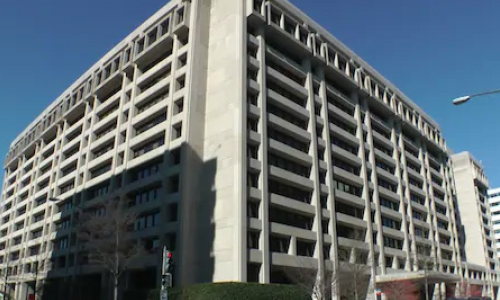
KABUL - The Executive Board of the International Monetary Fund (IMF) has completed the sixth and final review under the Extended Credit Facility (ECF) arrangement for the Islamic Republic of Afghanistan. a report from the world lender body said.
Completion of this review enables the disbursement of SDR 5.38 million (about US$ 7.4 million).
The three-and-half year ECF arrangement for SDR 32.38 million (about US$44.7 million or 10 percent of Afghanistan’s quota in the IMF) was approved by the IMF Executive Board on July 20, 2016 (See Press Release No. 16/348), to support the government’s reform efforts and to help catalyze donor funding.
A challenging political and security environment has constrained Afghanistan’s real GDP growth to below 3 percent in recent years. Most vulnerability and social indicators show Afghanistan trailing other low-income countries, with the poverty rate having risen to almost 55 percent.
The authorities have focused on maintaining macroeconomic and financial stability and pursuing reforms, guided by the Afghanistan National Peace and Development Framework.
Despite the difficult circumstances, program implementation has remained satisfactory, with all quantitative performance criteria and all but one structural benchmark under the ECF arrangement met.
The remaining structural benchmark, aimed at accelerating Kabul Bank asset recoveries, was implemented with delay in November.
Regarding the macroeconomic outlook, growth is projected at 3 percent in 2019, up from 2.7 percent in 2018, buoyed by a recovery in agriculture, and rising to 3.5 percent in 2020 before stabilizing at 4 percent in the medium term, assuming no significant security deterioration, continued reforms, and sustained aid inflows.
Inflation is expected to rise from an average of 0.6 percent in 2018 to reach 2 percent this year and rise gradually to 5 percent in the medium term, reflecting a pickup in economic activity.
Assuming continued grant inflows, fiscal and external balances are expected to remain sustainable. Risks to the outlook are tilted to the downside, and include a deterioration in security, heightened political tensions, a significant drop in aid, and reform slippages. On the upside, durable peace would boost confidence and economic activity, setting Afghanistan on a higher growth path.
Following the Executive Board discussion, Mr. Mitsuhiro Furusawa, Deputy Managing Director and Acting Chair, made the following statement:
“The Afghan authorities are to be commended for successfully completing their ECF-supported program.
They continue to implement their reform agenda consistent with Afghanistan’s National Peace and Development Framework, aimed at reducing poverty, raising inclusive growth, and boosting job opportunities for the growing labor force.
“The successful completion of the ECF arrangement demonstrates the authorities’ strong ownership of their reform agenda. The Fund continues to stand ready to assist Afghanistan, including through the provision of technical assistance.
The Executive Board also concluded the 2019 Article IV consultation with Afghanistan. (Pajhwok)
Home » Afghanistan » IMF Commends Afghan Govt Commitment to Economic Programme
IMF Commends Afghan Govt Commitment to Economic Programme