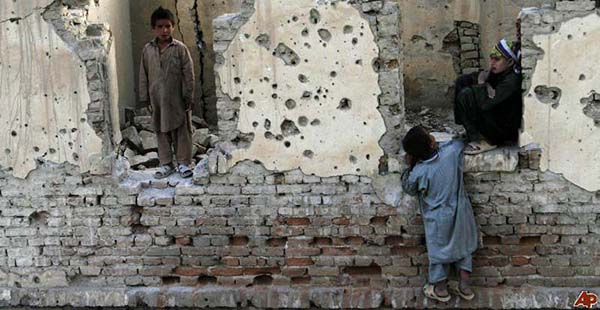
When I was a child, my mother was talking about the bodies torn to bloody shreds with fighters’ shells, thunder of the guns with the shrieks of the wounded populace writhing in pain, waste of the humble homes with hurricane fire, the hearts of the unoffending widows wrung with unavailing grief, the women turned out roofless, along with their children, wandering unfriended the wastes of the desolated land in rags and hunger and thirst, sports of the sun, flames of summer and the icy winds of winter, broken in spirit, worn with travail, imploring God for the refuge of the grave and denied it.
I felt bewildered, as my mother was speaking to me of sorcery, of inquisition, of an abominable, monstrous and horrible thing. She spoke of cannibals who were eating the flesh of their own species and it was awfully nauseous for me to imagine one with bloody claws and human blood rolling down the sides of their lips. My mother spoke of such barbarians who grinned proudly claiming their superiority through carnage and violence. The heartrending stories shocked me to the death and I was wondering how the human beings turn into wild animals!
How logically Dwight D. Eisenhower states: “Every gun that is made, every warship launched, every rocket fired signifies in the final sense, a theft from those who hunger and are not fed, those who are cold and are not clothed. This world in arms is not spending money alone. It is spending the sweat of its laborers, the genius of its scientists, the hopes of its children. This is not a way of life at all in any true sense. Under the clouds of war, it is humanity hanging on a cross of iron.”
Undeniably, Afghanistan has passed a bloody history and millions of Afghans wounded, killed and left homeless within the war periods. But my focus is not the casualties left be wars, rather it is about 8 Saur 1357 (solar year) and its consequences.
The Afghan Revolution and Civil War, Soviet intervention and Afghan resistance proved to be a pivotal series of events in the Cold War and the 1980s.
On 28 April 1978 (7 Saur 1357), the People's Democratic Party of Afghanistan (PDPA), a Marxist organization led by Nur Mohammed Taraki, seized control of the country. Babrak Karmal and Hafizullah Amin, key figures in the unfolding drama, also assumed prominent posts in the revolutionary government. Although Marxist, the new leaders insisted that they were not controlled by the Soviet Union and that their policies did not deviate from the principles of Afghan nationalism, Islamic justice and foreign policy nonalignment. The PDPA also promised to respect all agreements and treaties signed by previous Afghan governments.
Soon after seizing power, the Taraki regime announced a traditional Marxist-Leninist reform program, including the establishment of full women's rights and the implementation of land reform. Although the reforms threatened to undermine Afghan cultural traditions, widespread resistance did not begin until the summer of 1978 when revolts spread throughout Afghanistan's provinces and cities.
On 28 March 1979, Hafizullah Amin became prime minister, although Taraki retained some of his party posts. When anarchy continued to spread through the country, Amin asked for, and received, additional Soviet aid. Conditions continued to deteriorate, and on 14 September 1979, Taraki died in a confrontation with Amin's supporters. Finally, on the night of 24 December 1979, the Soviets began an invasion of Afghanistan - Amin died three days later. Karmal returned from the Soviet Union and became the new prime minister, president of the Revolutionary Council and secretary general of the PDPA.
Opposition to the Soviet troops and Karmal spread fast. By early the following year, several informal resistance groups, called the mujahedeen (warriors) emerged to resist the Soviets. The uprising grew in strength over the ensuing years, and on 4 May 1986, in a desperate move, Mohammad Najibullah, former head of the secret police, replaced Karmal as secretary general of the PDPA - Karmal soon lost all his posts.
In November 1987 a new constitution changed the name of the country back to the Republic of Afghanistan with Najibullah elected to the post of president, but Afghan resistance to the Soviets continued. By that time, the situation for the regime had become desperate; Afghan refugees in Pakistan and Iran numbered in the millions; and morale in the Afghan military was non-existent.
Finally, talks between Afghan foreign ministers and Pakistan diplomats were being held in Geneva under the supervision of the United Nations. Peace accords were finally signed in April 1988, only after Mikhail Gorbachev, the Soviet leader, promised to begin withdrawing Soviet troops in May of that year. The withdrawal began as scheduled, with the last Soviet soldier leaving on 15 February 1989.
After the Soviet withdrawal, civil war continued. The mujahedeen could not put a lid on the tension and formed an interim government in Pakistan and resisted all efforts at reconciliation. Najibullah was finally ousted from power in 1992.
After the fall of the communist Najibullah-regime in 1992, the Afghan political parties agreed on a peace and power-sharing agreement .The Peshawar Accords created the Islamic State of Afghanistan and appointed an interim government for a transitional period.
Finally, The Taliban started shelling Kabul in early 1995. They seized Kabul on September 27, 1996, and established the Islamic Emirate of Afghanistan. They imposed on the parts of Afghanistan under their control their political and judicial interpretation of Islam issuing edicts forbidding women to work outside the home, attend school, or to leave their homes unless accompanied by a male relative.
Following September 11, 2001 attacks, The US President George W. Bush accused Osama bin Laden and Khalid Sheikh Mohammed as the faces behind the attacks. When the Taliban refused to hand over bin Laden to US authorities and to disband al-Qaeda bases in Afghanistan, Operation Enduring Freedom was launched in which teams of American and British special forces worked with commanders of the United Front against the Taliban and this led to the fall of Taliban’s regime. Hence, a democratic government was established under the presidency of Hamid Karzai.