
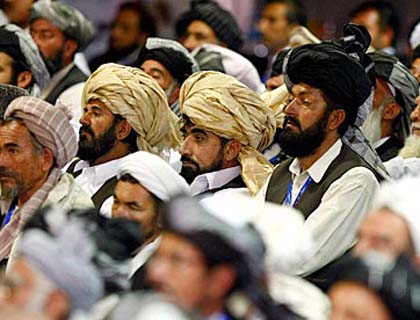
The vague destiny of Presidential Election has overshadowed several issues including peace negotiation with Taliban militants. Despite persistence of Mr. President in terms of so-called show of sincerity and seriousness in talks, Taliban militants have not given any signal which reflects a promising sign of visible change. With much diplomatic talks and fretting with Islamabad, Taliban key figures such as Mullah Turabi and Abdul Ghani Baradar, the second in command of Taliban, after Mullah Mohammad Omar, were released. But Kabul has no track of them but credible resources after confirmed that large of Taliban released simply rejoined militants and resuming killing civilian and government employees.
Mullah Abdul Ghani who attracted huge attention among officials vanished after his release from the prison and I do not think so that officials have any sort of clue about his whereabouts. Even if they know something, they might prefer to remain silent because he might have rejoined the group and planning deadly attacks on those who have left no stone unturned for his release.
A year ago, he was almost the headline of every newspaper. He became so much popular as our top officials were talking in manner that he had the capacity to put an end to present armed struggle once for all. But over a year past from time he stepped out of the door of prison, he has shown no move and has changed like hundreds of prisoners who enjoyed the sympathy of government and could vanish or rejoined militants.
Indeed, opening a diplomatic door with Taliban was not the idea of foreign allies from the start. Instead, during past years, they stood strongly behind military strategies to win anti-insurgency struggle in the country. However, the initial of Bush administration was good. Taliban could not stand against the military might of US-led international community; they could, in contrast to political and military calculations, rapidly change strategy and resurge back to the country. They used from those safe-hideouts and redesigned the strategy to fight against Kabul government and its foreign allies. After the successful resurgence, international community came into an understanding they underestimated militants and overestimated their influence over countries which had close ties with Emarat Islami.
But the recognition was too late. The water has already spilled to an infertile land and the tide changed. Many countries which had large support of civilians to fight against insurgency increasingly facing unexpected civilians pressure to pull back as soon as possible, in home. There remained no strong logic for them to justify the struggle taking lives of their troops and wasting billions of taxed dollars while the unemployment rate was in a horrifying level. So, time proved to be in the favor of militants.
Afghan people are worried about the future after withdrawal and many forecast about broke out civil war once again. Meanwhile, they are also disappointed and become sensitive about the presence of foreign. Of course there were several other principle factors fuelling further the mayhem like corruption, inefficient administration, presence of influential people who are charged of human rights violation within the government, recent unfortunate incidents which led to demonstrations and etc.
Thus, in order to break the tide once again, President Karzai launched a new initiative which was supported by foreign allies too---trying diplomatic measure and sitting with Taliban leaders on the negotiation table. In this sphere, Mr. President Karzia tried hard to persuade foreign allies to hand over the peace initiative entirely to his government, in which he succeeded. He and his government were entirely authorized to negotiate and bargain with militants.
All the measures held for bringing peace and stability have a certain failure. Against the overwhelming approval of Loya Jirga for resuming talks with militants, they assassinated the Chief of High Peace Council and former President, Mr. Burhanuddin Rabbani in his very house. But the process got no disruption from government. Instead of reassessing the strategy, government further pressed finger on peace alarms, irrespective of whether Taliban listen or not. Noticing the disparate struggle of Kabul for peace, both Taliban and its region supporters considered as weakness of government. Taliban leaders interpreted the sincere efforts of Kabul government as sign of its weakness and fear about the future. They thought that after 2014 all foreign security forces will certainly withdraw and similarly they will decline their financial, technical and logistic support for the Afghan government. Such process would leave the government so weak and exposed to armed struggle of Taliban and al-Qaeda.
Taliban still have not reviewed the same old mentality in spite of being aware of appropriate growth of Afghan soldiers in terms of coping with insurgency lonely. Though Mr. President still plead for peace which further strengthen the wrong concepts of Taliban, but I think analysts believe government would collapse unless some serious things happen within the structure.
Additionally, there is another factor that disinterest militants to resume peace talk that is the transfer of power to the next President. Both Abdullah Abdullah and Dr. Ashraf Ghani Ahmadzai till now have voiced a strong opposition to Taliban. If they remain committed to their slogans, the peace talk is going to be much more complicated. Hopefuly, the strategy of peace begging change into a serious dialogue from at least an equal status.