
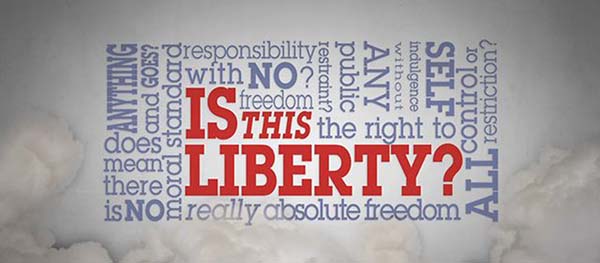
Liberalism supports individual freedom. It has promoted the law and private property, with free exchange of goods and ideas. Liberalism, as the name implies, is a broadminded belief in a political ideal where individuals are free to pursue their own goals, in their own ways, provided they do not infringe on the equal liberty of others.
Hence, it is primarily concerned with issues of human rights. Two prominent liberal philosophers put it this way: “Rights are the language which liberalism is spoken.” The entire liberal philosophy revolves around the primacy of the rights of the individual.
Thomas Jefferson put this liberal ideal into one succinct paragraph: “We hold these truths to be self-evident, that all men are created equal, that they are endowed by their Creator with certain inalienable Rights, that among these are life, Life, Liberty and the pursuit of Happiness, - That to secure these rights, Governments are instituted among Men, deriving their just powers from the consent of the Governed….”
It merits mentioning that liberalism first became a distinct political movement during the Age of Enlightenment, when it became popular among philosophers and economists in the West.
The 17th century philosopher John Locke is often credited with founding liberalism as a distinct philosophical tradition. Locke argued that each man has a natural right to life, liberty and property and according to the social contract; governments must not violate these rights.
Liberalism includes many significant elements which play critical role for supporting individual rights and social justice. I will write shortly about some of the elements.
The separation of power is one of the elements which prevents from power monopoly. Baron de Montesquieu, the French political philosopher, described the separation of political power among a legislature, an executive and a judiciary. His approach was to present and defend a form of government which was not excessively centralized in all its powers to a single monarch or similar ruler. Montesquieu based this model on the Constitution of the Roman Republic and the British constitutional system; he took the view that the Roman Republic had powers separated so that no one could usurp complete power. In the British constitutional system, he discerned a separation of powers among the monarch, Parliament and the courts of law.
Montesquieu specified that “the independence of the judiciary has to be real and not apparent merely.” And “The judiciary was generally seen as the most important of powers, independent and unchecked”, moreover, was considered perilous.
Religious tolerance is also one of the key parts of liberalism. Liberalists emerged after religious reformation and they embraced tolerance regarding the others’ beliefs. Religious tolerance is the policy to extend religious freedom to people of all religious traditions, even though one may well disagree with their beliefs and/or practices. Having tolerance toward another religion does not require you to endorse that faith group’s beliefs; it simply indicates one’s respect for its right to exist and for its member to hold different beliefs without being oppressed. This tolerance led to political tolerance as well.
In John Locke’s letter concerning toleration, he develops several lines of arguments that are intended to establish the proper spheres for religion and politics. His central claims are that government should not use force to try to bring people to the true religion and that religious societies are voluntary organizations that have no right to use coercive power over their own members or those outside their group. One recurring line of argument that Locke uses is explicitly religious. Locke argues that neither the example of Jesus nor the teaching of the New Testament gives any indication that force is a proper way to bring people to salvation. He also frequently points out what he takes to be clear evidence of hypocrisy, namely that those who are so quick to persecute others for small differences in worship or doctrine are relatively unconcerned with much more obvious moral sins that pose an even greater threat to their eternal state.
Civil society is also included in liberalism. One description puts it quite succinctly, “A civil society is a public space between the state, the market and the ordinary household, in which people can debate and tackle action.” Civil society is formed by people independently from the state. On the one hand, civil societies support public advantages and on the other hand they decentralize power through the rivalries they keep among themselves.
Public supervision over government is also instrumental in supporting the rights of people. Pessimism and cynical idea about government form an ideology in liberalism. John Locke believed that politicians are, potentially, fierce animals who make no bone about using power for their personal advantages. Hence, the officials are supposed to be under public supervision so as not to exploit their power.
Liberals typically believe that government is necessary to protect individuals from being harmed by others; but they also recognize that government itself can pose a threat to liberty. As Thomas Paine expressed that government is at best “a necessary evil.” Laws, judges and police are needed to secure the individual’s life and liberty, but their coercive power may also be turned against them. The problem, then, is to devise a system that gives government the power necessary to protect individual liberty but also prevents those who govern from abusing that power.
The priority of individual liberty to social justice also makes an element of the liberalism. Liberals are not against social justice; however, they believe that social justice is an instrument for gaining individual liberty. Moreover, they allow government’s intervention only if necessary and government should not sacrifice the individual liberty for the social justice.
It should be noted that liberalism is one of the intellectual bases of democracy. Thus, it is an inevitable entity in democratic countries. Of course, there will exist political, cultural, moral or economic liberalism in democratic countries.