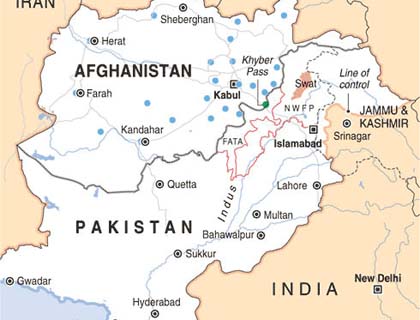
If you ask me whether Afghanistan is the main victim of terrorism or Pakistan, I really hesitate to say Afghanistan. However, Afghan people are nowadays defenseless against direct and indirect terroristic activities in their homeland, but the present condition of Pakistan does not seem much better. What remains as principle advantage of Pakistan is its strong military force which Afghanistan, unfortunately, is not entitled to.
But with much regret, let’s be frank and do not ignore the ground realities. Militants and terror organizations in both countries have been in ascending state during past years, and they elegantly succeeded exploiting the prevalent political uncertainty, recruit dissidents, enticing the lower layer of social class, and, more importantly, have launched extensive project of brainwashing and injecting Islamism to children as well as youngsters. Presently, both countries are desperately struggling to break the already tightened chain of militancy and terror organizations that everyday deal dented blows to social safety, political stability and economic development of both.
People both in Afghanistan and Pakistan are not unfamiliar with terrorist attacks. Every now and then, the civilian’s bloods make the soil red and leave their relatives and family members shed tears for their loss. Militants have killed more than thousands of people in AF-PAK territories and caused huge miseries for citizens. Meanwhile, the military and diplomatic measures of governments and international community are active but have been unable to change the situation tremendously. Pakistan is under the pressure of domestic as well as global view, forcing it to deal with issue of terrorism and terror activities with much more seriousness and firmness. At meantime, the international community is directly involved in the quagmire of its neighbor--Afghanistan. They have spent billions of dollars and sacrificed thousands of their armies in this soil to bring peace and stability and ensure that it may not become once again the center to global terrorism. However, they succeeded in the economic as well as in the ideological battle with militants to some extent. But, they bluntly have failed to achieve the intended goals in the diplomatic as well as military spheres. Today, domestic and foreign analysts alike do maintain that Afghan society has become more open and more provided for development of democratic institutions. Large numbers of people here do not appreciate an Islamist-tilted government any more, and today a civil potential has formed that desires to compromise between Sharia and modern values. On the other hand, they also maintain that Taliban militants and its al-Qaeda ally are much stronger and having further sophisticated establishment than few years ago.
So, one of the main questions has been for AFPAK and its international allies how to deal with militants and how to uproot them once for all. The problem is that no one knows the answer of this puzzle. The above question entails series of other questions regarding the issue. Who supports Taliban-like groups and al-Qaeda-like terror organizations? Are they in Afghanistan or beyond its borders? What is the force driving these groups---political, economic or ideological? Assessing the activities and behavior of international community, we can get still there are not any accurate answers on the table. What all totally accept is that various factors are interacting with one another which have caused the current global headache.
But, in order to break the chain and create disruption to this notorious cycle, Kabul and Islamabad, as I said the two main victims of terrorism, and their foreign allies have to prioritize and single out principle factors. As the President Karzai is soon going to say farewell as president, both countries need to work for closer relations. Presently there are reports that Pakistan’s intelligence is trying to disrupt the smooth process of presidential election, but Islamabad should have reached to a calculation that the world may not allow once again that this country changes into a safe haven for terrorism. Therefore, instead of engaging in disruptive activities, Pakistan accepts Afghanistan as an independent neighbor which has the authority to choose with whom it develops relation considering the concerns of its neighbor too. Both should understand that insurgents and terrorists do not care about anyone. Both countries will continue to be victims if bilateral relation is not strengthened to a proper level. As Pakistani officials during their visit from Kabul the common threat of terrorism could be tackled through enhanced economic ties and increased trade relations between Pakistan and Afghanistan. They stressed the improvement of economic relations could lead to development as well as change in the lives of the people, forming a basis to prepare a common strategy to confront the trends of extremism and militancy.
They were right to some extent. The improvement of economic condition can solve the problem of unemployment of civilians. So, for the sake of supporting their family members, there would be no need of joining militant groups who, ostensibly, pay them more.And the dissident from government also will find more compromising attitude towards welfare-program of the administration. But this charming theory may not be the same in practice. One of the best examples is Afghanistan’s provinces like Helmand where foreign donors poured money in order to win the heart and mind of civilians. And civilians in this province are far better economically than those of central provinces. But still Helmand has remained volatile and the center of anti-government and its international allies’ resistance.