
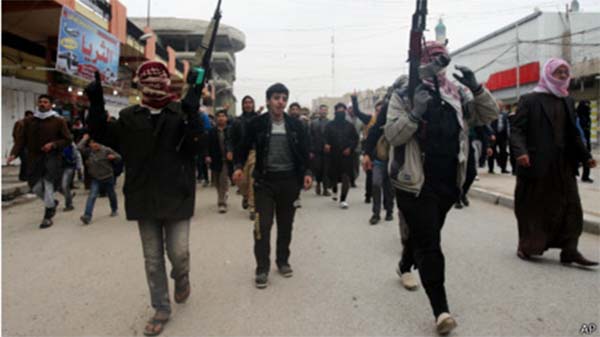
The spectacular success of Islamic militants in Iraq has sent shock waves down to spine of regional and Western countries. The fall of Mosul to hands of Islamic State of Iraq and Al-Sham (ISIS) last Tuesday once again turned the attention toward the country that what actually is going on underground. Despite robust condemnation and sympathy for Baghdad, none has promised clearly any kind of military support that presently Baghdad pleads the most.
During last one week, the cities of Iraq fall as there are no soldiers to stand against militants whose number does not go beyond few thousands. A day after the fall of Mosul, militants seized the Iraqi city of Tikrit on Wednesday but security forces thwarted an assault on Samarra as a lightning militant offensive launched in second city swept closer to Baghdad. Since the Islamic State of Iraq and the Levant began its spectacular assault in Mosul late Monday, militants have captured a large swathe of northern and north-central Iraq, prompting as many as half a million people to flee their homes
Last year when Fallujah fell to hands of Islamic militants, Baghdad and its allies tried their best to undercount the problem and brand it as minor security fixture that could be fixed with alliance of tribal heads that were deemed to be cooperative with Baghdad rather than Islamic militants. It was viewed that central government was only considerate of civilian casualties otherwise ISIS militants would be any easy task to be eradicated from the Anbar province. Baghdad also said that with the support of local tribes, the ISIS militants would soon be defeated. The local was required not because Iraqi soldiers are weak on incapable to push militants out but rather to minimize the civilian casualties.
Following the battle between militants and soldiers reflected a different story. There was not much support from the local tribes because they felt closer to militants rather to central government which has failed to draw of picture of being a national. Meanwhile, everybody seemed cool because ISIS and huge underground anti-Baghdad sentiments were underestimated which presently can explain the collapse of Mosul, Tikrit, Baiji and possibly Samera.
Iraq has more than 900,000 security personals which is not comparable to few thousands militants of ISIS. There are two justifications for such speed of fall of the cities to the hands militants. First one, there is growing dissent from the central government which is part of the blunt mistakes of Prime Minister Nouri-Al-Maliki. Irrespective of the sectarian conflicts, he did not make enough efforts to attract the attention of secular Sunnis who feel alienated as well as hurt of stripped of political power they held for decades.
Such sectarian resentment and alienation from the central government have pushed even Sunni secular forces closer to ISIS which already has started putting the rigid interpretation of Islamic Shariah under its control. Women are said to avoid any unnecessary going out of home and men should be present in Mosques in all five time prayers and etc.---perhaps equal what Taliban did in late 90s in Afghanistan. Such alienation is not only among common people also Sunni political parties. After the collapse of Mosul, Prime Minister Maliki called for an urgent parliamentary session on giving security forces great authority to deal with militants but it was cancelled because the quorum was not completed.
The second thing can be sectarianism within Iraqi forces. Soldiers and police just laid down their arms and escaped though they outnumbered ISIS militants. However, it is not clear but Mr. Maliki harshly criticized and talked of harsh punishment for security forces left even their weapons back.
Anyhow, the incident has also sparked serious regional reactions. After hostage of Turkish diplomats, Ankara threatened harsh reprisals if 49 Turks seized by the militants at its consulate in the main northern city were harmed in any way.Tehran and Washington, which despite their many differences have a shared interest in preventing Iraq following neighboring Syria into all-out civil war, both pledged more aid to Baghdad.
Meanwhile, ISIS vowed on Twitter that it would “not stop this series of blessed invasions” that has seen the fall of the whole of Nineveh province in the north and swathes of Kirkuk and Saleheddin provinces further south.“All of Tikrit is in the hands of the militants,” a police colonel said of the Salaheddin provincial capital, which lies half way between Baghdad and Mosul.
Washington has warned that ISIL threatens the entire region and promised more aid for the Baghdad government.State Department spokeswoman Jen Psaki said the US was committed to “working with the Iraqi government and leaders across Iraq to support a unified approach against ISIS’s continued aggression.”
In Tehran, Foreign Minister Mohammad JavadZarif said Iran “offers its support to the government and people of Iraq against terrorism.”
Perhaps, the situation goes like this and ISIS gets the name of the strongest Islamists group that can threaten the global security, Tehran will get the chance to develop closer relation with Washington which in turn irritates US-long standing allies in the region. But how the US may play with this new great may reflect the country’s skillful diplomats. Would it be able to get rid of Sunni radicals without angering its Arab Allies who indirectly support ISIS due to their opposition with Shiite dominance in the region?