
The way that the international community dealt with Syrian crisis they should have expected Islamists storm in other countries in the region. Now Iraq is the first of the country which has fallen victim to crisis broke out in Syria and it is now challenged by few thousand Islamic State of Iraq and Levant (ISIL) militants. The power of the Iraqi soldiers appeared to blunt false. Perhaps, they are good at nothing except receiving their salaries and sucking billions of public budgets that Baghdad spends. The fall of Mosul, one of the largest cities two weeks ago and the subsequent fall of other cities, particularly Beiji oil refinery facility which produces 300,000 of oil per day and used for domestic consumption proved that Iraqi soldiers are even unable to protect their weapons and headquarters against the aggression of Islamist militants who fight in numbers of fronts only with few thousand soldiers.
After the fall of Mosul 11 days ago when reportedly only few hundred ISIL militants courageously entered into the city and thousands of Iraqi soldiers just laid down their arms and started escaping from the city. Though some of them tried to merge in the public by wearing common cloths, but the subsequent videos released on the websites numbers were caught and executed without trail.
Since, Islamists continue annexing other cities to domain of their authority. The Mosul thrust many into shocks. Those who were in view that Iraqi soldiers were trained by United States and subsequently huge cost that it bears on public budgets, none could have ever imagined such Baghdad security collapse. The maps have been released from areas under the control of ISIL militants depict a new picture the country’s future. Iraqi cities fall into hands of militants one after another. Baghdad except sparking the sectarian feelings still failed to get support from Sunni sect against the terrorist group.
On Friday, militants captured town Qaim on the Syrian border and Raway town on the Euphrates on Saturday. They have continued capturing cities while the Baghdad looks with dazed and cannot do anything. On Sunday, they captured two other cities in Anbar province part of which has been under their control since January. Now the span of ISIL control has expanded into unexpected, large enough for establishment an Islamists government. While Syrian soldiers still stand strongly against ISIL and other far stronger and dangerous network, Baghdad cannot cope with few thousand militants.
The semi-independent Kurdish state government still kept away from engaging with militants. Seemingly, the state soldiers are alerted and would not make any move against Sunni radicals unless come under attack.
Ostensibly, the differences between Baghdad and Kurdish state have paved the way for silence of Kurdish state government. It feels that the more Baghdad comes under pressure the more it gets larger under its control particularly cities like Kirkuk on which Baghdad and State government have differences.
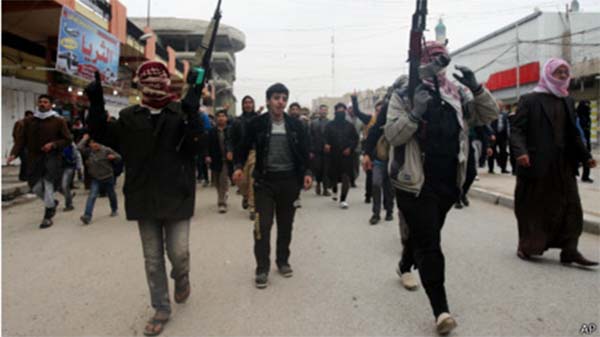
With stance from the Kurdish state government, Prime Minister Nouri Al-Maliki is further pushed toward sectarianism for which he is blamed. In order to prevent the fall of other cities and develop strong front against ISIL militants, he needs to depend on Shiite Radicals like that of Jaishul Mahdi. As on Saturday thousands of heavily-armed Shia militiamen paraded through several Iraqi cities as Sunni militants seized two strategically located towns in what appeared to be a new offensive in the western Anbar province.
To counter the radical Sunni militants, there are calls for Shiite armed militants which openly enjoy the supporter of government. When Prime Minister Nour Al-Maliki with the support of pummeled the Chaishul Mahdi militants led by Moqtada al-Sadr, the hardline Shia clerics, he was pursuing to establish a central government and strengthen the pillars of his government. Years later, it appears that without the support of the United States Iraq government cannot stand any potential domestic uprising.
Seemingly, the consecutive defeats at the battle field and possible aggression on Baghdad, forced the government to depend on the muscle of civilians as it wanted to do in Anbar province but failed. On Sunday, in Baghdad, about 20,000 men, many in combat gear, marched through the Sadr City district with assault rifles, machine guns, multiple rocket launchers, field artillery and missiles. Similar parades took place in the southern cities of Amarah and Basra.The parades were staged by followers of Shia cleric Muqtada Al Sadr, who once led a powerful militia that battled US troops and was blamed for some of the mass killing of Sunni civilians during the sectarian bloodletting that peaked in 2006 and 2007.
Similarly, the Iranian-born Al Sistani, believed to be 86, lives in the holy city of Najaf, south of Baghdad, where he rarely ventures out of his modest house and does not give media interviews. His call to arms last week prompted thousands of Shiites to volunteer to fight against the Sunni militants.His call to defend the country, and its Shia shrines, has given the fight against the Sunni insurgents the feel of a religious war, but his office in Najaf dismissed that charge, saying the top cleric was addressing all Iraqis.
Such inconsiderate arming of civilians will deepen the sectarian crisis. Baghdad is under pressure to bring back alienated Kurds and Sunnis to body of the government. Presently, it looks really hard for Maliki to accomplish the task he should have done before. He needs time to breath and thereafter think about developing a national government which looks really grim.