
His arrogance and pride have often led man to behave as an oppressor and a tyrant. Some men have been carried away by their own self-importance that they have even claimed divinity. Pharaoh, the ruler of Egypt, was among those who announced: “I am your supreme Lord!” With his sense of greatness and pride, Pharaoh subjugated the Israelites and made their lives wretched and miserable.
But is man really as strong and great as his ego tells him? The Holy Quran tells us the reality of man’s nature: “It is Allah Who created you in a state of weakness, then gave you strength after weakness, then after strength, gave you weakness and a hoary head: He creates what He wills, and He is the All-knowing, the All-powerful”
Weakness in the beginning and weakness in the end: This is the essence of man. He is so weak and helpless at birth that his entire existence depends on his parents and his family. If he were to be abandoned in these first crucial years, he could not survive on his own. He needs a gentle and loving hand, not only in his infancy, but in his childhood and even in his teenage years. As this child enters the years of youth and independence, he begins to take control of his own life. He looks with pride at his strong physique, his handsome features and his many talents. He begins to despise those of fewer abilities, even scorning his parents, who exhausted their own health to nurture him. He becomes unjust and cruel, using his strength and vigor to dominate others. He thinks he is master, free to act as he wills. But does this youth, these good looks last forever?
In only a few decades, he begins to lose his strength…his youth is replaced by old age. The real Master is Allah. He alone is mighty, He alone, is great. He alone is never tired, never needs rest, and is never dependent upon anyone. In our everyday lives, we say a warm thank you for the small acts of kindness which others do for us. So what about thanking Allah, Who, in His infinite Mercy, has provided for every single one of our needs. Just observe the beauty and perfection of the earth around you and fall down in gratitude to your Lord.
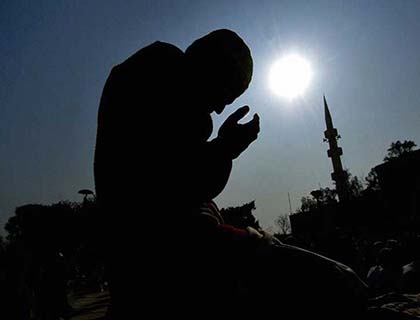
After the Messenger of Allah was commissioned for Prophethood, the first thing he was commanded to do by Allah was to pray.
It gives every Muslim the chance to communicate with his Lord. During each prayer, the Muslim recites some verses from Holy Quran. This recitation is not a dull monologue by the Believer, but Allah promises that it is a conversation between Him and the worshipper.
The Messenger of Allah once said: “Prayer is the pillar of religion.” He also informed us that Islam is built upon five pillars, the second being to establish prayer five times a day. This makes the image very clear: Islam is like a building supported by five columns; remove just one column and the entire building weakens. In the same way, when a person stops praying, his faith becomes weak, and the mildest blows can cause it to crumble. The prayer is so very important that the Prophet said: “Verily, between man and polytheism and disbelief is abandoning prayer.”
Allah has emphasized the need for humility and concentration in prayers. There is no doubt that Satan is the sworn enemy of man; he always tries to disturb the believer’s prayers. Man was created only to worship Allah. In other words, man is to live in this world as a worshipper of Allah and prayer is the best form of worship. On the Day of Judgment, man will have to answer for his deeds. Allah says: “Then shall you be questioned about the joy [you indulged in].”
It merits mentioning that most major religions involve prayer in one way or another. Some ritualize the act of prayer, requiring a strict sequence of actions or placing a restriction on who is permitted to pray, while others teach that prayer may be practiced spontaneously by anyone at any time.
Whether an extremist who refuses to send his sick child to a doctor because he believes that prayer is the only healer, or one who seeks to be rich, famous and secure by manipulating the Universe's forces of attraction, this approach to prayer does need to be challenged because it is not effective and can be destructive. “I prayed to God for healing, and the person died anyway!” One may cry. “Therefore, there is no God, God does not care, my prayers were not sincere, or the person somehow deserved to die.” What terrible choices, leaving one feeling abused, disillusioned, deluded or impotent.
Prayer is not a mysterious practice reserved only for clergy and the religiously devout. Prayer is simply communicating with God - listening and talking to him. Believers can pray from the heart, freely, spontaneously, and in their own words.
In Islam, the human will is submissive to that of God's will. Therefore, prayers are not to be used for fulfillment of human needs, but only a mean to worship The Infinite Divine. Prayer can be performed in silence, in utterance, in remembrance or stillness. This concept is beautifully expressed in the spiritual poetry of Rumi: “In all six directions, (N.S.E.W. Up, Down) I will bow my head to Thee alone. The gardens, the flowers, the birds, the sounds and sights, are, but signs of continuous worship of Your Infinite Presence.”
Ramadan, which is called “the spring of Holy Quran”, is the best month for Muslims to communicate with Allah. Lucky are those who spend this month praying soulfully and purifying his spirit from all evils. Luckier are those whose personalities are changed within this month and they never intend to return to evils and immoralities. Let us at least eschew the sin and crime and fulfill our religious obligations in this holy month.