
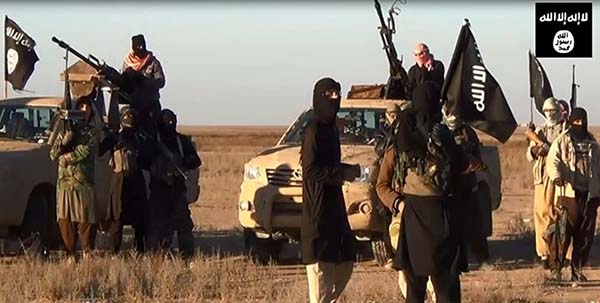
It has been almost three weeks of the Mosul and several other cities’ fall, but the government has failed to push the militants back. The Beiji oil refinery facility which normally produces 300,000 barrel per day is still controlled by Islamic State of Iraq and Levant (ISIL) militants. The ground attacks on the position of militants till now have been fiercely responded, moreover, bombs and explosive devices have made the aggression slower.
The spectacular victories of ISIL militants in the country late last month reflected how weak the Iraqi soldiers are. Except its terrifying number---more than nine hundred thousand, Iraqi security establishment has nothing enough to count on. It is really hard to call them as trained soldiers because armed civilians also may not give up the battle front that easily when they are in comparable in terms of number. But Iraqi security forces by handing over Mosul, one of the largest cities and several other small cities brought shame for Baghdad and indeed also displayed the disaster within the back bone of Iraqi security forces. Perhaps, it is a large establishment sucking billions of dollars but unable to cope with few thousand of ISIL militants inside its border.
After preparation and support from neighboring country with announcement of Jihad from some cleric leaders, fierce battle goes on for pushing militants out of Tikrit. But there is not lightening hope for pushing few thousand ISIL militants that spread to a large area in Iraq and Syria. Last year when Fallujah fell to hands of Islamic militants, Baghdad and its allies tried their best to undercount the problem and brand it as minor security fixture that could be fixed with alliance of tribal heads that were deemed to be cooperative with Baghdad rather than Islamic militants. It was viewed that central government only considerate of civilian casualties otherwise ISIS militants would be any easy task to be eradicated from the Anbar province. Baghdad also said that with the support of local tribes, the ISIS militants would soon be defeated. The local was required not because Iraqi soldiers are weak on incapable to push militants out but rather to minimize the civilian casualties.
The following the battle between militants and soldiers reflected a different story. There was not much support from the local tribes because they felt closer to militants rather to central government which has failed to draw of picture of being a national. Meanwhile, everybody seemed cool because ISIS and huge underground anti-Baghdad sentiments were underestimated which presently can explain the collapse of Mosul, Tikrit, Baiji and possibly Samera.
Iraq has more than 900,000 security personals which is not comparable to few thousands militants of ISIS. There two justification for such speed of fall of the cities to the hands militants. First one, there is growing dissent from the central government which is part of the blunt mistakes of Mr. prime Minister Nouri-Al-Maliki. Irrespective of the sectarian conflicts, he did not make enough efforts to attract the attention of secular Sunnis who feel alienated as well as hurt of stripped of political power they held for decades.
Such sectarian resentment and alienation from the central government have pushed even Sunni secular forces closer to ISIS which already has started putting the rigid interpretation of Islamic Shariah under its control. Women are said to avoid any unnecessary going out of home and men should be present in Mosques in all five time prayers and etc. ---perhaps equal what Taliban did in late 90s in Afghanistan. Such alienation is not only among common people also Sunni political parties. After the collapse of Mosul, Prime Minister Maliki called for an urgent parliamentary session on giving security forces great authority to deal with militants but it was cancelled because the quorum was not completed.
Presently, the problem of Iraq seems far deeper the mere attack of a new phase of Iraqi al-Qaeda. After the election, still it is not clear how the government will be established. Prime Minister Nouri al-Maliki is struggling to maintain his position though he has not gained the largest seat but he hopes he once again attracts the attention of small Shiite political parties and establish a government without engagement of mainstream Sunni political parties which may further alienate Sunni sect from Baghdad.
On Tuesday, the new parliament failed to elect a speaker as its first session ended in disarray on Tuesday, with MPs due to meet again in a week.Lawmakers were constitutionally required to choose a speaker in their first session, followed over a period of weeks by the selection of a new president, who names a presumptive prime minister.But a number of MPs failed to return after a 30-minute break meant to restore order, and the session broke down into a debate over whether there were enough lawmakers present to continue.Under de facto agreements after past elections, the parliament speaker has generally been a Sunni, the prime minister a Shia, and the president a Kurd.
The situation has turned much complicated as Baghdad was looking forward for the support of Kurds Peshmarga force which is viewed experienced and battle-hardened than Baghdad security forces. Masoud Barzani the chief of the Kurd state has talked about a referendum would be held within the coming months for independence. If the lasting dream of Kurds come into the reality, than it would be a start for new regional map as Kurds in three countries, Turkey, Syria and Iran may try to join the newly established government. Similarly, Baghdad Shiite government may not be able to cope with Sunni radicals if it does not take serious steps to re-engaged the sect in the government.
The legislative chaos comes despite repeated international appeals for unity as Iraq faces a major militant offensive that has overrun swathes of five provinces north and west of Baghdad.