
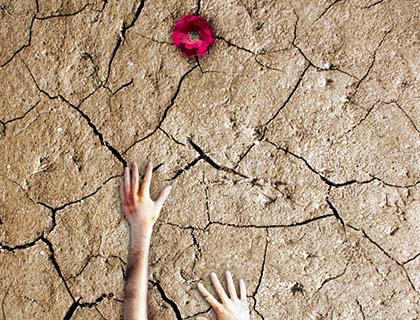
As an Afghan citizen, whenever I hear the phrase ‘violence against women’ I, uncontrollably, imagine an addicted man with a keen knife in his hand and her wild laughter resounding in a pitch black cellar walking towards a woman to harm her. In the meantime, I hear the woman sobbing with utmost chagrin imploring the man not to hurt her. After black and white pictures blinking before my eyes for a moment, I see the woman unconscious and blood gushing from her wounds made by the man’s knife.
The truth is that a backlash against women rights campaigns started back in 2001 after the overthrow of the Taliban. Its first public face was the young TV presenter Shaima Rezayee. Accused of flirting on TV, the music show presenter was found shot dead in 2005. The murder was never fully investigated but rumors abounded that hers was a Taliban murder or maybe an “honor killing”. That these two possibilities could be expressed in one breath showed that the misogyny of the average Afghan family was perhaps not vastly different from that of a Taliban state.
Shaima’s killing made it clear: if there was another part that was ready to suppress them. Women soon discovered that the enemies of women’s rights were as omnipresent as dust, god and corruption. Neologisms such as “the Talib in suits” or “the tie-wearing Talib” were coined to sum up encounters with misogynist men dressed up as progressives. Some of them held PhDs. Others were Fulbright scholars. But a university degree was not guarantee for a progressive mind.
At the time of Taliban regime, women were treated as pariah and a creature to sit behind closed doors and be used as a mere tool for satisfying the carnal desire of men. Sometimes, as only bread-winners for their children, when they dared come out for finding a morsel of bread, they were shrouded in burqa. Going to school was a big crime for them. Women were flogged and killed in desert courts for breaking the norms which were necessarily considered by the Taliban. In other words, coming out without burqa or with the men who were not the close members of their families were crime and they deserved serious punishment. After the fall of Taliban’s regime, Afghan women sighed deeply with relief thinking that violence has been ended against them and now they are equal to men. But unfortunately, equality of rights was no more than a dream and they were being tortured by their spouses, fathers, etc.
In a recent report, the graph of women’s casualties have raised more than the last month. The women do not only lose their near and dear ones in terrorist acts but also their own lives. Although, the civilians especially women and children are faultless, their indiscriminate murder demonstrates the irrationality and barbarity of religious extremists. Of course, the radicals have showed it time and gain that violence and irrationality run in their blood and they will never give up such inhumanities.
It is an undeniable fact that women have undergone cruel treatment throughout the human history. In primitive societies they were considered inferior to men. For instance, they were sold in groups as slaves, given as debt, buried alive, arrested to be revenged, etc. Women have slaved indoors twenty four hours a day and treated as pariahs. She was not allowed to step outside or to speak with a man without the permission of her husband. Moreover, even her birth embittered the life for her father and he turned black with rage by the news of his daughter’s birth.
Walby, an analyst in patriarchal study who used to live in 19th century, divides patriarchy into two types which are private patriarchy and public patriarchy. Private patriarchy is a dominance which is imposed on woman from patriarch side in a family. Private patriarchy is a strategy based on denying and ostracism, because women are ostracized and prevented from partaking in social life. On the other hand, public patriarchy has general form. Women are involved in public places such as policy and social work, however, stay away from wealth, power and position.
The same private and public patriarchies are being practiced across our country. Women suffer violence severely indoors and outdoors. Even though she is laboring twenty-four/seven, she is insulted, misbehaved, abused, tormented or even tortured to death. The girls are forced to marry whoever is selected by their fathers and however he is. Her dignity is broken through being used as a tool for satiating the carnal desire of men. Some unlucky girls fell victim of violence in their infancy that hardly ever survive. This is the violence used indoors.
Giuseppe Mazzini says very nicely, “The angel of the family is one’s woman. Mother, wife, or sister, a woman is the caress of life, the soothing sweetness of affection, a reflection for all individuals of the loving providence which watches over humanity. In her there is a wealth of tenderness to allay every pain. Moreover, for every one of us she is the initiator of the future. The mother’s first kiss teaches the child love; the first holy kiss of the woman he loves teaches man about hope and faith in life. This love and faith create a desire for perfection and the ability to reach step by step progress. It creates the short future, of which the living symbol is the child; a link between us and the generations to come. Through her, the family with its divine mystery of reproduction, points to eternity.”
The high graph of women’s casualties in the current year is a matter of great concern. I believe that urging the religious extremists to avoid this crime will be, as usual, in vain. Rather government officials should think of an effective mechanism to prevent from the casualties of the vulnerable parts of the society. In short, keeping silent about such violence will reveal the officials’ unconcern or inability to bring their murder or the violence against them to a halt.