
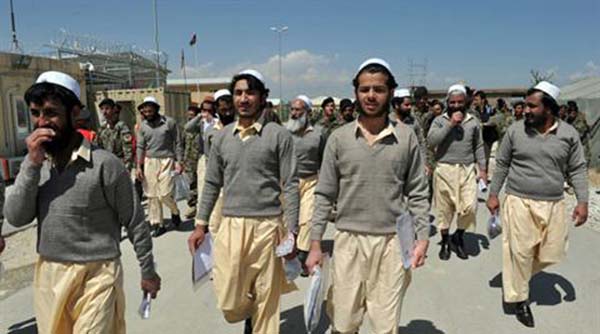
Previously, the three member Panel, Criminal Cases Review Commission, assigned by President Hamid Karzai to look into the cases of Bagram Prisoners have once again put a stone into the water of stormy political situation. Two days ago, the commission announced that it had reviewed 764 cases during past nine months.
It found the cases of only 114 of them suspicious which referred to Attorney General for further investigation. The rest, 650 of them, were released over what the commission said lack of evidence against them. On the other hand, MPs, civil society and US officials unanimously voiced out concern over the decision of the commission. According to Afghan and American military officials, there are 88 highly dangerous prisoners who are included in the release list. “These are guys that are tied directly to killing and trying to kill our forces and Afghan forces,” an American military official said. “This is an issue of deep concern. It is serious.”
The commission disagrees. Abdul Shakor Dadras, a member of the three-man panel, said there was no real evidence against any of the men, who are among the 650 prisoners the panel has ordered freed since President Karzai created it after the transfer of the prison in March.
In an interview last week, Mr. Dadras said that President Karzai tentatively approved the releases at a cabinet meeting last week. The President, he said, ordered the commission to ask the international military coalition and the main Afghan intelligence agency to produce evidence against the detainees. But seemingly, the pressure of American officials and evidence provided by Afghan and foreign intelligence could not get the satisfaction of the commission. Irrespective of huge concerns, it is confirmed that from 88 prisoners who are considered highly dangerous, 72 of them would be released.
The pending wave of releases has revived one of the most caustic issues between the allies just as relations have hit a new low over President Karzai’s refusal to sign a long-term security agreement with American officials. Officials from both countries who support the security deal say they are worried that the mass release of militants with American blood on their hands could scuttle talks altogether and lead to a complete Western withdrawal from Afghanistan in 2014. It was out of concern that dangerous militants might be too easily returned to the battlefield that American military commanders initially resisted President Karzai’s demands in the spring to hand over all detention operations. As the Americans relented, they said they had received his personal assurances that security would be maintained.
Suddenly, it is a major issue again, though the releases have not been made final. But American and Afghan security officials, who have spoken on the condition of anonymity because of tensions between the countries, said they had already given the commission enough evidence to send all the detainees in question to trial. The officials say that they have evidence linking the detainees to the killings of 117 American, European and Afghan service members and civilians, and that they are ready to continue investigating in cases where more evidence is needed to try the men.
One of the detainees was caught planting a hidden bomb and was linked by biometric evidence to other bomb attacks that killed two Afghan soldiers, the officials said. Another is alleged to have trained and deployed teenage boys for suicide attacks. A third placed a hidden bomb outside a school, killing a student, the officials said. Both the Afghan defense officials and the Americans argued that under the deal that transferred control of the prison, the commission did not have the authority to order the releases over the objection of the coalition and the intelligence service, which is supposed to make a recommendation on each case. The commission “has exceeded its mandate and ordered the release of a number of dangerous individuals who are legitimate threats and for whom there is strong evidence supporting prosecution or further investigation,” said Col. David Lapan, a spokesman for American forces in Afghanistan.
American and Afghan defense officials say there is ample evidence of freed insurgents returning to the battlefield. One case cited by Afghan officials was that of Mullah Ghulam Mohammad, who was detained by coalition forces in northern Badghis Province. He was freed last year after pressure from some Afghan officials and has since returned to Badghis, where he now commands an estimated 500 fighters, said Qazi Abdul Rahim Raheen, a Member of Parliament from the region, citing a briefing by Afghan intelligence officials.
It is not clear why the commission acts so hastily over releasing the prisoners despite whopping evidence of return to battlefield. Several militants who were released caught again fighting Afghan security forces. Some of them turn as hero to their region and become as inspiration for the rest of battalions to fight government without fear because they believed that Allah Almighty had saved them. They do not believe it was the government that saved them.
I think Afghan officials should understand that they indeed are not saving lives through releasing a suicide bomber rather they are risking lives. Trail of a suicide bomber will save the lives of tens of civilians who will be lost as result of explosion. Government should notice that by releasing 88 dangerous militants, it would save 88 lives but may risk the lives of hundreds of civilians and Afghan security forces who will be killed by direct Talibans’ operations.