
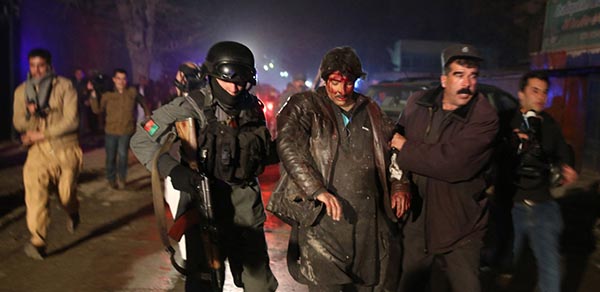
Amidst the uncertainty about the future of an international role in Afghanistan’s security, the Taliban suicide attack in Kabul shocked the world. The attack which claimed lives of many foreign nationals, including the head of the International Monitory Fund (IMF) office in Afghanistan and UN employees, is coming at a time when the Taliban are reinforcing their activities and organizing terrorist attacks across the country. The attack on the Lebanese restaurant in Kabul has brought a global condemnation with the UN head Ban Ki Moon calling it horrific.
The attack in Kabul was followed after a series of attacks organized by the militant groups in Kabul and other cities which came after a lull and ease of insurgent attacks in the country. It once again highlighted the worrisome prospect of Afghanistan’s security as the insurgent groups are struggling to make a fresh momentum ahead of the April’s presidential election. The Taliban have claimed responsibility for the attack.
In recent months and weeks, the militant groups have organized assaults on security personnel and government and military installations. More notable has been the group’s resurgence in rural and far remote areas of insecure provinces in the south and east of the country. The Friday attack in Kabul happened shortly after the Taliban’s allegation of being in the course of victory against Afghan and foreign forces. Taliban spokesman Zabihullah Mujahid has said that the militant group was ‘confident for victory’ over US forces in Afghanistan, boasting that their fighters were everywhere in far remote areas of the provinces particularly the southern Helmand province.
Earlier, a British military official and an American intelligence assessment said that there were the possibility for the Taliban to make resurgence and threaten the achievements of the past twelve years including regaining territories in the south and west. These were other alarms about a possible comeback of the Taliban after withdrawal of foreign forces. All these worrisome warnings are indicating that there are conclusions that the Taliban might be able to threaten the mild peace and stability. Though a full-scale resurgence seems highly unlikely, but the fact is that the possibility for the Taliban to threaten security, particularly that of the election is quite possible.
The Friday spectacular assault on the highly-fortified embassy district in Kabul suggests that the Taliban are attempting to renew their high-profile assaults on government installations and the Western interests in Afghanistan. The sharp rise in violence in Afghanistan and the Taliban’s increased activities to disrupt security ahead of the forthcoming elections is of profound concerns. The worsening situation is a troublesome sign for the ongoing security transition and the upcoming presidential elections. As the election date is getting nearer by each day, the militant groups seem determined to increase their campaign of violence ahead of April’s presidential and provincial council elections, with the aim to derail the crucial political transition in the country.
Afghan officials assured recently that the Afghan forces will be able to provide security for the vast majority of polling stations in the forthcoming presidential elections. The officials who have provided a plan for security arrangements for the upcoming elections to the electoral authorities is ensuring has also said that more than four hundred polling centers would remain closed due to insecurity. The assurances come at a time when the security across the country is constantly deteriorating, and the insurgents have been organizing concerted attacks in the first days of 2014. Given that in wintertime the violence is expected to decline, the sudden rise in violence is a trouble sign of the security situation in the country in a crucial year with two important transitions underway.
Taliban’s intensified campaign of violence needs to be dealt efficiently by security agencies, as the militants will most likely attempt to intensify their attacks for derailing the upcoming presidential elections. A deterioration of security across the country could result to closing of polling stations in many parts of the insecure areas of the South and East of the country which could potentially damage the legitimacy of the elections and the country’s political stability. Furthermore, it is the time for the Afghan government to end the impasse with Washington over the bilateral security agreement and ensure that the US and NATO will promptly provide extensive security support to Afghan forces.
Seemingly, the attack also sent a message to the efforts of the Afghan government and the United States to resolve the impasse and agree on a much-awaited security deal that would allow US forces to stay in Afghanistan through 2024. Despite it, the message the international community and the Afghan government get might be different from what is aimed by the Taliban. The recent rise in violence is coming at a time when the Afghan government and the United are not making any progress in resolving the impasse over the bilateral security agreement.
Such events would possibly increase public pressures on the Afghan government to do more to resolve the stalemate. These attacks and the subsequent reactions in the national and international levels put a lot of pressures on the Afghan government to review its current approaches towards both the bilateral security agreement with the United States and the prisoners release program of the government, both of which have been very controversial issues recently. Subsequent to the attack, the calls for stopping the arbitrary release of Taliban prisoners once again echoed among Afghans through the social-networking websites on the internet.