
“I am somebody. I may be poor, but I am somebody! I may be on welfare, but I am somebody. I may be uneducated, but I am somebody. I must be. I’m God’s child. I must be respected and protected. I am black and I am beautiful. I am somebody. Soul power!” Jesse Jackson.
The origins of the term “civil society” date back to ancient Greece. It was revitalized at the end of the seventeenth century as political thinkers sought to understand the enormous social and political changes that were occurring as a result of early capitalism. It fell into disuse again in the early twentieth century, but in the 1980s east European dissidents resurrected the term to articulate their demands for democracy. With the collapse of the Soviet state socialism, the term entered the political discourse of international development, and what resulted was, according to Gasius et al, “an uneasy coalition between local and imported or imposed versions of civil society.”
This hope is justified, I believe, not just because the mores of civility suggest an aspiration toward more harmonious social relation, but also because the historical development of civil society has been a vital force in the creation of modern democracy and continues to play that role today. Civil society’s complex framework of freedoms, rights, common commitments, and procedures for peaceful dispute resolution is the source of its promise for the future.
While civil society provides an enabling framework for democracy, it contains at the same time an intrinsic tension, a fragile balance between private and public interests. Maintaining this balance is essential to finding solutions to vital challenges in modern democracies that demand public resolution, challenges such as environmental degradation, fundamental educational needs, ethnic and religious strife, and deterioration of public decision-making processes. These are often described as issues of the commons, the resolution of which will determine the future of humankind.
The term “civil society” has been used in Afghanistan since at least 2001 when it was decided that the views of civil society should be taken into account during the Bonn peace process. A separate conference for civil society participants was arranged alongside the political and diplomatic one. Assistance in the process was provided by international actors, notably Swiss peace. The term was used by the World Bank and other international bodies and this led some Afghans to believe that the concept was a western import and therefore problematic.
Even though, the civil society activists play a key role in our country, it seems that the government is not willing to support the activists and their civil objectives. In other words, civil movements are devalued in a so-called democratic country, where the officials are corrupt.
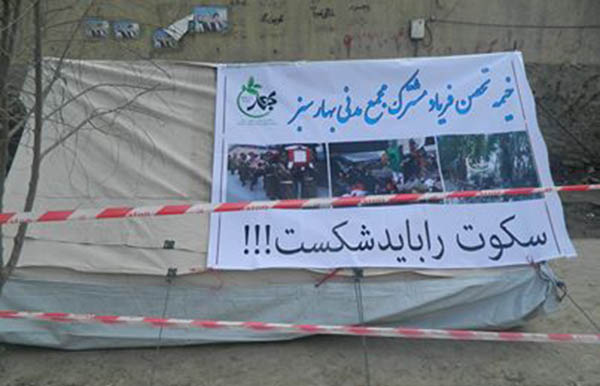
A sit-in launched by a number of civil society activists 22 days ago in Kabul, has been ignored by the government. They are passing cold days and nights in camps to reflect the injustice going on in our country. The activists raise their voice against cruelties inflicted on Afghan nation by the Taliban insurgents, urging the government to stop negotiation with the Afghans’ enemies.
Mrs. Zahra Sepehr, who leads the sit-in, says, “It is not a right thing for Afghan women, who have lost their husbands in battlefields, to beg on streets and neither for their children to abandon their schools for economic constraint.” She adds, “It should be clear for our soldiers that weather they are fighting against their brothers or enemies in the battlefield! Why does our President call the terrorists brother? If this matter does not be clear for our forces, their morale will be faded away, they will abandon their job or even join Taliban militants. Moreover, our soldiers’ salary should be paid on time otherwise they will lose their interests.” She further says that the women activists also represent those women who fall victims of their husbands’ rage and suffer seriously from domestic violence.
Mrs. Sepehr points out that the civil society activists do not demand individual rights of the protesters thorough their sit-in, however, they demand the rights of a nation who fell victim for keeping silence and the movement supports the families victimized by terrorists. According to her, Afghan citizens should attain their civil rights.
The demands of civil society activists who are conducting the sit-in are written shortly as: Naming Taliban as the enemies of Afghans and abolishing High Peace Council (HPC). On time supply of the logistical and weaponry needs of the armed forces, especially the first aid needs for the wounded soldiers on the battle ground. On time payment to Afghan forces for their piece of mind. Providing social and economic supports to the martyrs and victims’ families such as residential estates; job opportunities for the survivors; constant financial support to the martyrs’ families who have lost their bread-winners; educational institutions for their children; etc. Presidential candidates should clear their positions regarding the Taliban and their strategy on dealing with the families of those martyred and other victims of terrorism.
No doubt, civil rights is a set of personal rights acquired by an individual by being a citizen or resident or automatic entitlements to certain freedoms and conferred by law or custom. In other words, civil rights, such as the right to equality, freedom, good governance, justice and due process of law, are inalienable like human rights and natural rights which are supposed to be provided by government regardless of race, gender, sect, etc. In case, if the rights are violated, the citizens can launch a non-violent protest. Then, it is the responsibility of the government to pay attention to the citizens’ demands.
I would like to conclude with the nice statement of Jack Canfield, “One individual can begin a movement that turns the tide of history. Martin Luther King in the civil rights movement, Mohandas Gandhi in India, Nelson Mandela in South Africa are examples of people standing up with courage and non-violence to bring about needed changes.”