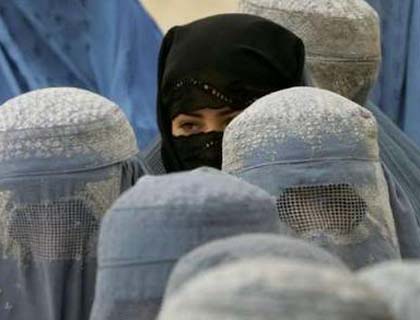
Before the U.S.-led invasion of Afghanistan in 2001, the Taliban pressed a strict interpretation of Islam that severely curtailed the rights of women. Women could not hold jobs or attend school and could not leave their house without being accompanied by a male relative. Offenders were publicly flogged or executed.
Since the fall of the Taliban, Afghan women's rights have expanded significantly. The country's current constitution affords equal protection to men and women, guaranteeing women the right to education, political participation and economic opportunity. Afghan women are now employed at jobs ranging from doctor to police officer -- unthinkable under the Taliban.
But still there are many challenges ahead of Afghan women and they suffer domestic and social violence. Moreover, insecurity and terrorism has compounded their problems which are explained shortly.
The struggle to secure women’s rights in Afghanistan has been an embattled one. After years of faltering campaigns, the landmark Elimination of Violence against Women Act (EVAW) was passed in 2009 by presidential decree. The unprecedented law criminalizes 22 offences, from forced prostitution to denying women their inheritance (Article 5), prescribes punishments for offenders (Articles 17 – 42) and outlines a number of state responsibilities (Articles 8 – 16). Most significantly, Article 6 enshrines seven victims’ rights, including the right of prosecution, legal representation and compensation.
The 2009 act marked a major turning point in the legal status of Afghan women. Before the EVAW was passed, cases of violence against women were governed by Afghanistan’s penal code, in force since 1976, which contains no reference to violence within the family or underage marriage. Even these scant legal protections were illusory during Taliban rule, when women were denied free movement and access to education and when women were even stoned to death. Since then, Afghanistan has signed numerous international rights treaties and as a signatory is obliged under international law to respond to reports of attacks on women. And yet, according to UN statistics, out of 650 reported cases between October 2012 and September 2013, the law was applied in a mere 109. On average, over the past three years, the EVAW act has only been applied to between 15 and 17 percent of reported cases.
Despite the presence of foreign forces, here in the last half of 2013, two consecutive Ministry of Women’s Affairs chiefs were assassinated. In August, female parliamentarian Fariba Ahmadi Kakar was kidnapped by Taliban militants. A few days later, the vehicle envoy of female Roh Gul was ambushed, leading to the death of her 8-year-old daughter. And the highest ranking police office in Helmand Province, Lt. Nigar, was killed just months after her predecessor’s assassination.
The truth is that a backlash against women rights campaigns started back in 2001 after the overthrow of the Taliban. Its first public face was the young TV presenter Shaima Rezayee. Accused of flirting on TV, the music show presenter was found shot dead in 2005. The murder was never fully investigated but rumors abounded that hers was a Taliban murder or maybe an “honor killing”. That these two possibilities could be expressed in one breath showed that the misogyny of the average Afghan family was perhaps not vastly different from that of a Taliban state.
Shaima’s killing made it clear: if there was another part that was ready to suppress them. Women soon discovered that the enemies of women’s rights were as omnipresent as dust, god and corruption. Neologisms such as “the Talib in suits” or “the tie-wearing Talib” were coined to sum up encounters with misogynist men dressed up as progressives. Some of them held PhDs. Others were Fulbright scholars. But a university degree was not guarantee for a progressive mind.
I remember a video of a young Afghan woman who was shot by her husband just few months ago. Indeed, it was one of the most saddening experiences. She was lying on the hospital bed, half of her face was riddled with shots. Trying to speak, her voice thickened with tears but she was swallowing them back. The big lump in her throat did not let her speak and all she could was shedding tears. Her old mother was explaining how her husband fired at her face she also burst into tears.
Afghan authorities are called to take much greater steps to both facilitate reporting of incidents of violence against women and lunch immediate investigatory cells in districts and division level facilitating the prosecution. As long as women and girls in Afghanistan are subject to violence with impunity, little meaningful and sustainable progress for women’s rights can be achieved in the country.
Recently, there is a real feeling among Afghan women that all the gains they have made in the past decade could vanish overnight. Women’s rights in Afghanistan are as fragile as the Afghan government and national army that are supposed to protect them. And outside of Kabul – in the provinces – there are still conservative elements sympathetic to the Taliban that can make life difficult for girls and women.
In addition, with Afghans’ presidential election just few weeks away, hopes for free and fair elections depend heavily on the full inclusion of women in the ongoing political process. Afghanistan’s future may rest on the peaceful transition of political power, but the April 5th elections will also prove a critical test of the nation’s commitment to preserve the rights and freedoms of Afghan women which are recently secured to some extent.
While preparations to secure polling stations are underway, threats against Afghan women at the polls have gone unchecked. Time is running short to make significant progress in the securing of polling stations, which could dramatically limit the opportunity for females to vote. Media, civil society, NGOs are working to counter challenges by engaging women to boost voter turnout, but concerns mount that a shortage of female security staff at the polling stations could limit participation by women.