
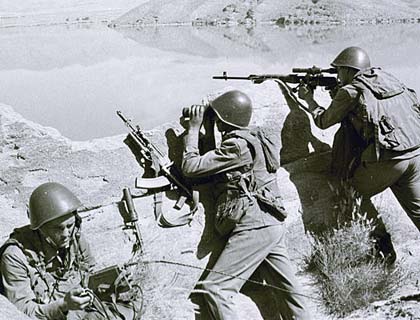
To many observers of the Afghan conflict, it seems as if the world suddenly discovered Afghanistan after 9/11 attack in 2001. Passing interest following the Soviet invasion in 1979 and the subsequent struggle of the Mujahedeen against its occupation was soon replaced by war weariness and disinterest. The rise of the Taliban and their draconian policies made Afghanistan a pariah state. A great change took place with the US attack on Afghanistan, the defeat of the Taliban and the installation of an interim multiethnic government. However, some are fully aware of the plight of the main victims of this tragedy, the women and children of Afghanistan.
The Soviet invasion of Afghanistan in 1979 and the subsequent brutal military campaign resulted in one of the biggest humanitarian crises of modern history, with over five million refugees fleeing to Pakistan and Iran and another two million displaced internally. The massive exodus of almost a quarter of the Afghan population, of which three quarters were women and children, was a consequence of several factors. These included fear of the Soviet occupying army and the pro-Soviet regime and widespread destruction of homes and livelihoods.
Most of the civilian and childhood casualties of the prolonged war in Afghanistan were the direct result of ballistic or landmine injuries. Compared with Bosnia, Cambodia, and Mozambique, Afghanistan had the highest population based rates of landmine injuries and the highest mortality. In a gruesome demonstration of specific targeting of children by the Soviets, many of the mines deployed were shaped as colorful toys or “butterflies.”
By the time the Soviet Union withdrew from Afghanistan in 1989, it had suffered over 50000 documented casualties. The local populace and the Mujahedeen had, however, paid a terrible price in destruction, death, and disability. Magnus and Naby prophetically stated: “Truly this became a generation that sacrificed itself. A world that does not help to reconstruct their country and find meaning for their loss may pay the price in warriors for hire, which disrupts not only Afghan tranquility but stability in many corners of the world.”
Unfortunately, the development assistance and support offered for economic and social recovery to Afghanistan were negligible, and what followed was a sorry tale of societal breakdown, lawlessness, and internecine conflict. As always, the most vulnerable in Afghan society bore the brunt of the continuing conflict.
The Taliban movement grew from the Afghan orphans or refugee children who attended madrasahs. Their rapid rise to power in 1994 must be seen in the context of chaos and civil war in Afghanistan, with warlords running amok and complete breakdown of law and order. The small band of Taliban was first led by Mullah Umar against a local warlord in Spin-Boldak and led to the capture of Kandahar in November 1994, with scarcely a shot being fired. The subsequent rise and spread of the Taliban in Afghanistan surprised most observers, and was generally welcomed by a war weary and destitute population.
To the development agencies the Taliban government brought some respite from incessant conflict. However, their tribal and medieval interpretation of Islam led to the imposition of draconian policies restricting the rights of women and ethnic minorities. Their edicts on female education, dress code, and employment were largely based on an extremely orthodox misinterpretation of Islamic law, and a source of great distress to many in the Islamic world. In an ironic twist of fate, the Taliban era also saw Afghanistan suffer from one of the worst droughts of this century, which virtually wiped out many sectors of a largely agrarian economy. Despite plentiful evidence of the impact of economic sanctions on the most vulnerable in society, especially children, Afghanistan was progressively deprived of assistance to the extent that even humanitarian agencies found it difficult to operate.
Notwithstanding the hardship due to drought and sanctions, the Taliban policies brought disproportionate suffering and impoverishment to war widows and families in Afghanistan. Food shortages and malnutrition had their biggest impact on Afghan girl children. Less obvious are the psychological trauma and mental stress experienced by Afghan women and children and the impact of continued illegal conscription of child soldiers by all warring factions.
The lasting impact of war on the psychological state of women and children is well described. Many have post-traumatic stress as a consequence of witnessing or experiencing parental loss in war. Political repression and state terror have also been shown to result in significant psychological sequelae.
A landmark survey conducted by UNICEF, few years ago, on the effect of war on children aged 8-18 years in Kabul indicated that 41% had lost one or more parents because of the conflict, and over half had witnessed torture or violent death. Over 90% of the children interviewed expressed the fear of dying in the conflict. A particularly gruesome practice of encouraging children to witness public amputations and executions has an enormous impact on impressionable minds. Over 80% of the children interviewed felt they could not cope with events and that life was not worth living.
While such events can lead to considerable psychological trauma and distress, they may also inure a young mind to violence. The average Taliban and Northern Alliance soldiers are a product of the same cycle of violence and social upheaval experienced from early childhood. Ignorance, isolation, and a daily ritual of violence greatly temper their vision of the world.
Morally, the experience of indifference from the surrounding world, or, worse still, malevolence may cause children to suffer loss of meaning in their construction of themselves in their world. They may have to change their moral structure and lie, steal, and sell sex to survive. They may have their moral structure forcibly dismantled and replaced in training to kill as part of a military force.
The great significance of history is beyond doubt. Indeed, history is a practical lesson for a nation to learn so that they do not repeat their political blunders any more. Hope it will be a lesson for our nation, especially for our political leaders.