
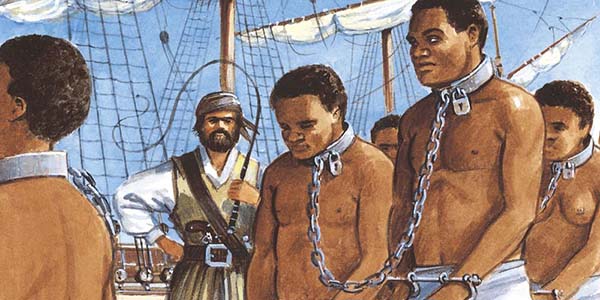
Slavery has existed, in one form or another, throughout the whole of human history. So, too, have movements to free large or distinct groups of slaves. However, abolitionism should be distinguished from efforts to help a particular group of slaves, or to restrict one practice, such as the slave trade.
Slavery can be traced back to the earliest records, such as the Code of Hammurabi (1760 BC), which refers to it an established institution. Slavery is rare among hunter-gatherer populations, as it is developed as a system of social stratification. Slavery typically also requires as a shortage of labor and a surplus of land to be viable. David P. Forsythe wrote: “The fact remained that at the beginning of the nineteenth century an estimated three-quarters of all people alive were trapped in bondage against their will either in some form of slavery or serfdom.”
Slavery was also common practice and an integral component of ancient Greece, as it was in other societies of the time, including ancient Israel and early Christian societies. It is estimated that in Athens, the majority of citizens owned at least one slave.
Romans inherited the institution of slavery from the Greeks. As the Roman Republic expanded outward, it enslaved entire populations, thus ensuring an ample supply of laborers to work in Rome’s farms and households. The people subjected to Roman slavery came from all over Europe and the Mediterranean. Finally, such oppression by an elite minority led to slave revolts; the Third Servile War led by Spartacus was the most famous and severe. According to history, Greeks, Berbers, Germans, Britons, Slavs, Thracians, Celts, Jews, Arabs and many more ethnic groups were enslaved to be sued for labor, and also for amusement (e.g. gladiators, and sex slaves). If a slave ran away, he was liable to be crucified. By the late Republican era, slavery had become a vital economic pillar in the wealth of Rome. In the Rome Empire, probably over 25% of the empire’s population and 30 to 40% of the population of Italy was enslaved.
During the Middle Ages, capture in war, voluntary servitude and debt slavery became common within the British Isles. Slaves were routinely traded. Running away was also common and slavery was never a major economic factor in the British Isles. Ireland and Denmark provided markets for captured Anglo-Saxon and Celtic slaves.
By the middle of the 18th century, British Jamaica and French Saint-Domingue had become the largest slave societies of the region, and the Caribbean was rivaling Brazil as a destination for enslaved Africans. Due to overwork and tropical diseases, the death rates for Caribbean slaves were greater than birth rates. The conditions led to increasing numbers of slave revolts, escaped slaves forming Maroon communities and fighting guerrilla wars against the plantation owners. By 1778, the French were importing approximately 13,000 Africans for enslavement yearly to the French West Indies.
Britain played a prominent role in the Atlantic slave trade, especially after 1600. Slavery was a legal institution in all of the 13 American colonies and Canada, acquired by Britain in 1763. The profits of the slave trade and of West Indian plantations amounted to 5% of the British economy at the time of the Industrial Revolution.
David Livingstone wrote of the slave trades: “To overdraw its evils is a simple impossibility …. We passed a slave woman shot or stabbed through the body and lying on the path. [Onlookers] said an Arab who passed early that morning had done it in anger at losing the price he had given for her, because she was unable to walk any longer. We passed a woman tied by the neck to a tree and dead …. We came upon a man dead from starvation …. The strangest disease I have seen in this country seems really to be broken heartedness, and it attacks free men who have been captured and made slaves.”
Livingstone estimated that 80,000 Africans died each year before ever reaching the slave markets of Zanzibar. Zanzibar was once East Africa’s main slave-trading port, and under Omani Arabs in the 19th century as many as 50,000 slaves were passing through the city each year.
Prior to the 16th century, the bulk of slaves exported from Africa were shipped from East Africa to the Arabian Peninsula. Zanzibar became a leading port in this trade. Arab slave traders differed from European ones in that they would often conduct raiding expeditions themselves, sometimes penetrating deep into the continent. They also differed in that their market greatly preferred the purchase of female slaves over male ones.
Although there were numerous slave revolts in the Caribbean, the only successful uprising came in the French colony of Haiti in the 1790s, where the slaves rose up, killed the mulattoes and whites, and established the independent Republic of Haiti. Europe recoiled in horror.
The Northern states of the United States abolished slavery, partly in response to the Declaration of Independence, between 1777 and 1804. Britain ended slavery in its empire in the 1830s.The bloody American civil war ended slavery in the US in 1865. The system ended in Cuba and Brazil in the 1880s because it was no longer profitable for the owners. Slavery continued to exist in Africa, where Arab slave traders raided black areas for new captives to be sold in the system. European colonial rule and diplomatic pressure slowly put an end to the trade, and finally to the practice of slavery itself.
The Slavery Abolition Act passed in 1833, outlawed slavery itself in throughout all British Empire with some exceptions. In 1834 all slaves in the British West Indies, were emancipated, but still indentured to their former owners in an apprenticeship system. The intention was to educate former slaves to a trade but instead allowed slave owners to maintain ownership illegally. The act was finally repealed in 1838.