
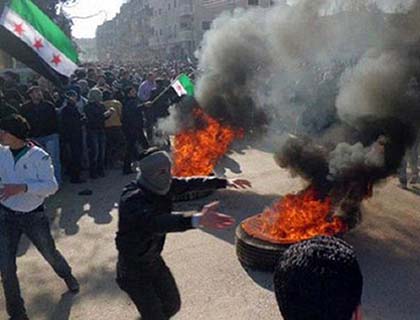
Seemingly, the world has forgotten all about Syria. The “Arab Spring” ostensibly was nothing other than a curse whiff for some Arab countries. It broke out for democracy and economic reforms but what actually brought was another “apocalyptic” period. The present civil war is not on headlines of any global newspapers as it looks that the loss of a Malaysian airplane is far more important that millions of Syrians living a miserable live in the neighboring countries which have supported fight against the government.
I think the refugee life may teach Syrians what Afghans have learned during last decades. Syrians may one day will understand that pouring or getting arms from neighboring countries were a deadly mistake that they could have ever committed. The sympathy shown by the rest of countries was just a crocodile tears and the tragic war will leave nothing from once a strong nation.
The situation has gone out of control of Syrians. It looks unwise to say that Syrians should hold back and forget all about democracy and economic reforms but the ongoing situation definitely will not lead to such objectives. The ongoing tragedy is led unfortunately by individuals other than Syrians. There are four scenarios all of them doomed to failure.
First: the radical supporters of President Assad who are of the view that government is in a stronger position and the continuance of war might finally end up to complete obliteration of rebellions. They are trying their best to motivate President Assad to keep tighter fist on power and never compromise with his oppositions. Indeed, this wing from the very start of insurgency has tried to show that rebellions have no ground support rather the stooges of foreign countries who are plotting to oust Assad regime. By branding rebellions as terrorists, they also tried to weaken their status at national and global level.
Second scenario which is also supported by Assad supporter is that the regime should remain strong enough to stand against insurgents but with difference that they, unlike the first group, support a diplomatic approach too. This think that the collapse of the government will led to uncontrollable consequences for the region and for the world. The main objective of this category is not elimination of oppositions rather they deem them as power that should be negotiated with. But negotiation should be made on regime’s terms and conditions. In other words, they have lost hope for complete crackdown of uprising due to span and depth of civilians’ dissent from the government.
The collapse of the regime means losing a close ally in the region and loss to their global and regional rivals. Russia spearhead this front albeit with cooperation of the first category. From the very start of uprising and growing support for rebellions, Russia and China have stood against the motion. They do not want to see that model of Libya be applied in Syria too.
So, according to the regime of President Assad should not collapse rather it should be kept but should negotiate with oppositions. Meanwhile negotiations should not compromise the regime’spower rather President should remain in power till the end of his presidential incumbency. And he should facilitate and pave the way for a peaceful transition. This on one hand will prevent the certain wreak of havoc which may be release after the collapse of the central on other hand comparatively cheaper way to the crisis.
The third scenario which is supported by some Arab countries is based on the collapse of President Assad. This scenario indeed circulates over the notion that the regime has committed horrible crimes. It started to suppress its oppositions from the very start of uprising. Perhaps, if President Assad stepped aside, Syrians would not have suffered as they are now suffering---more than 100,000 dead and millions migrated to neighboring countries. In other words, he is blamed of crime against humanity and guilty for tens of death.
Such an issue has disqualified him to continue as a president. He lost the ground support. Thus, he should be toppled at all cost because he has no right to remain in power. Radical armed groups and many Arab countries indeed favor this scenario. From the very start, they developed their strategy on a Syria without Assad. This theory was largely strengthened with oust of Presidents of Tunisia, Egypt and Libya. The calculation was this that President Assad regime was doomed to the destiny of three other regimes.
The fourth scenario for peace is empowerment of oppositions to a level that force the regime to strike a deal with them. President Assad frequently called armed opposition terrorists who are the stooges of Syria’s enemies. He rejected any call to sit with them and find a diplomatic solution to the problem. However, recently both sides pretend to hold peace talks but each side paid deaf ears to conditions of the other side or completely rejected. The earlier plan of Russia and US to bring together government and opposition, hoping to prevent bloodshed in the country, has now remained in the condition of uncertainty. The meeting was not held because both sides offered conditions that were not acceptable for the other side. Both sides are trying their best to appear from a stronger position thus intensifying struggle to capture large chunk of the country.
The only solution to the problem is the sympathy of neighboring and global countries to just give up interfering into domestic affairs of the country. The solution lies into kindness of countries trying to collapse the government or defeat oppositions that just give up dragging Syrians into swimming pool of blood. Training insurgents and pouring arms will not unravel the country from the imposed tragedy rather will deteriorate the situation. So, it would be so kind of involved countries that they should not shed crocodile tears for Syrians rather just pull back and let them to live with dignity rather buying their daughters as servants.