
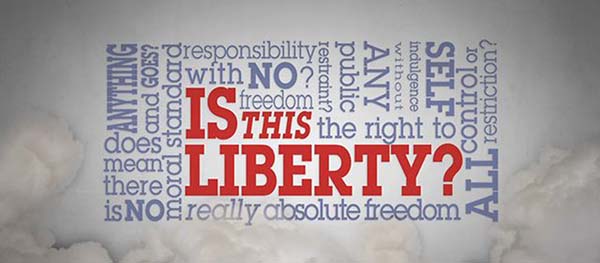
“I began to question the liberal doctrine of man. The more I observed the tragedies of history and man’s shameful inclination to choose the low road, the more I came to see the depths and strength of sin … I realized that liberalism had been all too sentimental concerning human nature and that it leaned toward a false idealism.” Martin Luther King, Jr.
It seems that a bewildering multitude of isms and schools of thought have surrounded our social lives. I believe that the deeper you go in, the more puzzled you will get. Generally, these isms branch out and give birth to many other opinions. Liberalism is one of those schools of thought which have challenged religious society and conservative individuals. Liberalism is in conflict with conservative beliefs and contradicts its religious principles to a large extent. Before knowing the conflicting points, let us see what is meant by the term “liberalism.”
This is not at all an easy question to answer and as we proceed with the lectures we shall see how complex and multifaceted such liberal ideas are. However, as a starting position, we might say that political liberalism involves a commitment to individual freedom understood primarily as the absence of interference and coercion; political and civil equality. It says that individual freedom and equality can be best protected by a set of rights which will define an area of private life within which the individual should be free from the control of the state or for that matter from the potential coercion civil institutions including faith communities; a commitment to toleration of thought and action at least in so far as action does not coerce others so that individuals are free to pursue their own conception of the good free from coercion so long as that pursuit does not harmfully or coercively affect others.
It maintains that there is a sharp distinction to be drawn between the public and the private or put another way between the state and society so that freedom, equality and rights provide a framework for the protection of private and voluntary practices against the encroachments of the state. It holds the view that it is not the function of the state to articulate or follow any specific conception of the good whether religious or ideological but rather that it exists to provide a neutral framework within which individuals pursue their own good in their own way.
Citizenship in such a state is defined in terms of these principles and rights, it is not to be defined in terms of the pursuit of some collective good or goal whether religious, moral or ideological and one’s citizenship is not changed or modified by the comprehensive sets of beliefs including religious beliefs that one might hold and stays the same between individual citizens who may hold mutually incompatible sets of beliefs.
Mostly liberalism is used as a term contrary to conservatism and there are many conflicting points between these two schools of thought. For instance, in a liberal idea, a woman has the right to decide what to do with her body. A fetus is not a human life, so it does not have separate individual rights. The government should provide taxpayer funded abortions for women who cannot afford them. The decision to have an abortion is a personal choice of a woman regarding her own body, and the government must protect this right. Women have the right to affordable, safe and legal abortions, including partial birth abortion.
But according to conservative belief, human life begins at conception. An abortion amounts to the murder of a human being. An unborn baby, as a living human being, has separate rights from those of the mother. Oppose taxpayer-funded abortion. Taxpayer dollars should not be used for the government to provide abortions. Support legislation to prohibit partial birth abortions, called the “Partial Birth Abortion Ban.”
Historically, liberal ideology originated in the Greek cities where the citizens were provided with vast freedom. However, looking at modern liberalism, one finds that it originates in the renaissance and reformation of the 18thcentury. Primarily, liberalism emerged as an anti-dictatorship movement and then changed to a school of thought, which also included further economic and political issues. In the beginning, it was a movement against the church and its authoritarianism. Therefore, there is a deep relation between liberalism and reformation led my Martin Luther and John Calvin which was the first step against religious authoritarianism and led to the establishing of protestant concepts against the Catholic Church. I can say that Protestantism was based on individualism which led to tolerance. Hence, it shook hands with liberalism in spreading individualism and unlimited freedom. Politically, liberalism revolted against authoritarianism and despotism and economically it revolted against feudalism. In short, one can conclude that liberalism was based on many schools of thought such as humanism, individualism, rationalism, scientism, anti-traditionalism, modernism, etc. and acts against monism, authoritarianism, elitism, determinism, collectivism etc.
Liberalism shows a great tendency towards secular ideas; so religious instructions are seriously marginalized in this school of thought. In other words, liberalism provides freedom at the cost of one’s beliefs and religious principles. Hence, when there are no boundaries and limits attached to liberty, it will lead to many challenges. I believe that wherever the role of religion is diminished, that society will encounter a moral decline. Certainly, freedom empty of faith and principle will give birth to moral corruptions which are contrary to religion and morality.
Martin Luther King, Jr. says, “I also came to see that the superficial optimism of liberalism concerning human nature has overlooked the fact that reason is darkened by sin. The more I thought about human nature, the more I saw how our tragic inclination for sin encourages us to rationalize our actions. Liberalism failed to show that reason by itself is little more than an instrument to justify man’s defensive ways of thinking. Reason, devoid of the purifying power of faith, can never free itself from distortions and rationalizations.”