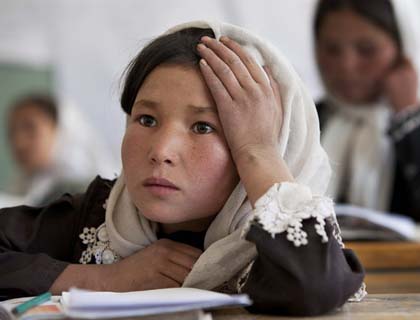
The present situation of education in the country may be tolerable but at any cost, it cannot be considered satisfactory. Now that 12 years have passed and all our excuses of previous destruction, lack of infrastructure and limitations of resources have started fading out, it is the time to revisit our achievements in these twelve years and see if the present scenario and setup is going to address the educational needs of the nation.
After the restoration of a democratic government in the country, the system of education also started from zero just like the other fields of life. Although the achievements made by other fields is also not much remarkable and even satisfactory and most of the funds provided by the international community for the development of country went into the pockets of a limited few but education cannot be compared to other fields. When the reconstruction of country started, most of the hopes were pinned with the education sector because our major problem was the absence of a nation that should be educated, skilled and ready to meet the present day challenges.
With this ideology in mind, international community started a wide-spanned campaign in the country that included of building schools and universities, upgrading the academic and infrastructural status of present institutes, building the capacity of teachers and many more. Millions of children were enrolled in schools in all parts of the country and number of students entering the university entrance examination considerably increased. This strategy can be termed as ‘war strategy’ because such a setup usually doesn't work in normal circumstances. Having a look at the immediate need of nation to increase school enrollment and meet the needs of millions of students willing to get educated, many compromises were made.
Due to the insufficient number of schools, two and in some cases, three shifts were organized in schools. As is clear, the hours students received were not sufficient for proper education. Because of this condition, large numbers of students were enrolled but the overall standard of education deteriorated. As mentioned earlier, such a step and its resultant consequences were taken as temporary and it was hoped that with the passage of time, more and more schools would be established that would help resolve this problem and overall standard of education would elevate but even after twelve years, same old strategy is at work and no kind of considerable improvement has been made in this regard.
It is the reason why, our school graduates can be termed as one of the weakest among the developing and third-world countries and this condition can be really detrimental if it continued in the same pattern. Our school graduates not only suffer in their university education but they also perform badly in their practical lives.
When we come to the university education, the situation seems to be even worse comparing to the schools. State-owned universities are more or less run and administered according to the same setup that was in use more than three decades ago. The administrative techniques are the same which has greatly reduced and negatively affected the overall achievements of these universities. Majority of the workers in administration are those who worked before the civil war of country and they are not ready to either give up their jobs or accept the modern and effective techniques of education. The authoritative style of teachers still persists that creates so many problems for the open thinking of students. Almost all the lectures are delivered in the national languages of Dari and Pashto which creates numerous problems to the students when they enter their practical lives.
The limited number of state-owned universities was never enough to meet the needs of increasing number of students who passed university entrance examination held by the ministry of education which gave way to the private universities. Till 2012, they were given the names of ‘Institutes of Higher Education’ that offered programs till graduation. In the beginning, the numbers of private universities were limited but when they proved to be much profitable, large numbers of such institutions were opened and now we can find such institutes on every corner of Kabul. More or less, same is the situation in other major cities of the country.
After 2012, some of these institutes of higher education got the status of universities and they started offering Masters Programs. But their condition was never satisfactory; both as institutes of higher education and now as universities. A university is regarded as a grand setup of education. Large number of factors like high qualified professors and lecturers, the administration staff, libraries, state of the art laboratories, and so many other factors are regarded compulsory for an institute to qualify as a university. It is a sad fact that, except for the American University of Afghanistan, none of the private universities qualify to be called a university. Most of these universities are run in a single building and one feels ashamed to read their boards to be claiming to be university. More than 95% of these private universities don’t have internationally qualified teachers, some of them don’t have any laboratories and some have similar to those found usually in poorly-administered schools. They usually hire teachers from the local markets who are not capable of teaching or from the neighboring countries where low quality teachers can be found on meager salaries. Due to the given conditions, our students graduate from university with poor knowledge and almost zero practical work understanding and turn out to be poor performers in the practical lives. It is the reason why, all the international NGOs and business organizations prefer university graduates of other countries like Pakistan, India, Philippine and others to the Afghans.
In the university level, biggest problem is emerging due to the lack of strategic policy. The job market in Afghanistan and the world is based on English and it is the reason why, all the private universities have adopted English as mode of education and books of international universities are taught. On the other hand, our public schools, from where the majority of university students come, have almost no English. Due to this problem, our students suffer a lot to understand their lectures and it is the reason that any university graduate who knows English to some extent, can be chosen by the university as a teacher.
The above mentioned poor conditions of schools and universities in the country are giving birth to so many problems. Now is the time that concerned ministries should start working to enhance quality and not the quantity. On school level, the books should be updated, teachers should be trained well and timing of classes should be brought to that of international standards. In universities, only high-qualified people should be taken as lecturers and professors, the international requirements for universities should be made compulsory for private universities, licenses should be issued after great care and checking and similar steps should be taken. If the present condition persisted, we would be producing large number of high school and university graduates who would be of no use to the country or society.